Grand Junction Airport Ambush
The Dog StarsThe Grand Junction Airport Ambush turns Hig’s long-held hope of finding survivors into a trap, exposing the airport’s radio signal as bait and forcing him to confront the people who control the tower. Its first warning is not a voice but the sight of aircraft burned in place, followed by a cable stretched across the runway.
Approach and Recognition
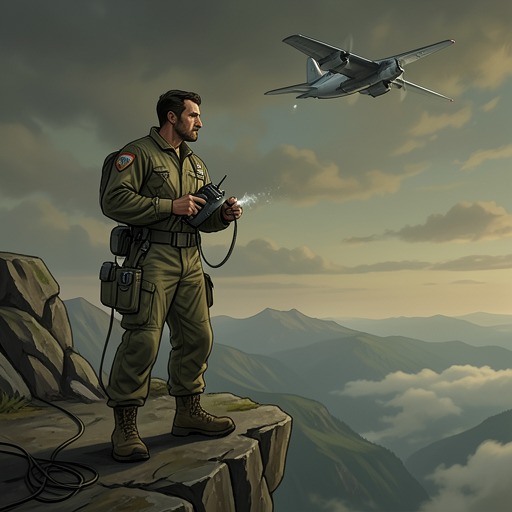
Hig approaches Grand Junction six miles out, at nine hundred feet, aiming for the airport tower where he had received the beginning of a message three years earlier. The frequency is still stored in his GPS. He calls the tower, repeats the transmission, and hears static; the signal briefly makes contact seem possible. Below him, the city is burned and devastated, though pockets of green trees remain. Pops, holding a lamb, watches the scene without reacting to the smell of sickness in the plane or the devastation below.
As Hig descends, the airport comes into view: damaged hangars, wrecked planes beside the runway, and a large jet at its far end. The wreckage initially resembles the weather-tossed aircraft he has seen at other airfields, but then he recognizes the difference. These planes are scorched and crumpled, wrecked with their engines running—not merely torn loose by wind. At about thirty feet above the ground, Hig abandons his planned landing flare, pulls back hard on the yoke, and pushes the throttle forward. The engine catches, and the aircraft surges back into the air as the lambs cry out.
A cable springs taut beneath the aircraft, missing its wheels by about ten feet. The runway was rigged as a trap. The escape leaves little margin for another attempt: Hig sees that only two gallons of fuel remain, at most ten minutes’ worth. The airport has shifted in an instant from the destination that promised an answer to a hostile place where landing could mean capture or death.
The Second Landing and the Voice in the Tower
With almost no fuel left, Hig turns back for a second approach, propelled by anger at the people who have turned the old radio signal into a lure. He abandons the checklists and lands fast, touching down a hundred feet beyond the cable. Pops tells him to keep taxiing and directs him to park behind a building west of the tower. After the first escape from the runway, Bangley had given Hig a rare thumbs-up; now there is no time to dwell on it or answer the tower.
The radio crackles with a voice that first sounds like Aunt Bee, then hardens into something frayed and mocking. The speaker laughs and tells Hig he is the first. Hig does not reply. He turns onto a broad taxiway and gets the aircraft under cover in the shadow of Big River Flight School and Authorized Cessna Service Center. The building’s wall blocks their view of the tower and, more importantly, prevents whoever is up there from getting a clear shot at them.
The danger has not ended with the landing. Pops squeezes out of the plane after Hig moves his seat forward, while Cima remains buckled in place, unable at first to respond to what has happened. Hig opens her door and sees her hand pressed against the panel over the oil-pressure gauge and a fresh bruise spreading along her forearm. Her eyes are bleary; she is in shock. The contrast between the anticipated welcome of a surviving community and the concealed runway trap makes the city itself part of the betrayal, not merely the people firing from its tower.
The Tower Assault
Before leaving cover, Hig gives Cima a charged gun and tells her to shoot anyone who approaches who does not look like him or Pops. He then takes the AR and handheld radio, tunes to the tower frequency, and retrieves the grenades hidden beneath one of the lambs. Bangley’s lessons shape the cautious advance: conversation with an enemy may sometimes be useful, but so is silence—and overwhelming firepower. Hig and Pops hug the building’s south wall, staying out of sight as they move toward the FBO offices. The next crossing is exposed: roughly fifty yards of open ramp to a single-story brick building with dark windows and a metal door at the rear.
Pops recognizes something in the tower voice, saying that the old woman sounds like his grandmother. The remark does not make the encounter safe or soften the danger; the pair continue toward the FBO, where Pops can get inside while Hig remains outside. A minute later, Pops signals him over with a hand held up, calming the rush. He explains that the tower’s thick bulletproof windows have gunports, and that once inside he had time to arrange a shot. The airport’s defenses, designed to protect its occupants, have also made a narrow firing aperture the weakness through which Pops can reach the shooter.
Inside the octagonal tower, Hig finds the gunman alive and badly wounded on the painted steel floor. He is an old man, older than Pops, with a white beard and blood-soaked, matted hair. His rifle, an AR-10 with a long barrel, lies nearby; his cap bears the words Peoria Jet Center and a claim to service the heartland. Hig recognizes him as the likely source of the radio call he heard years earlier. The old man’s plea for Pops to finish him confirms that the shot through the gunport has not yet killed him.
The woman Hig had heard on the radio is Aunt Bee. She stands beside a spotting scope, dressed in a blue-cornflower calico dress, frozen between the navigation screen and a lunge toward the wounded man. Her cry identifies the shooter as Samuel, her husband. Pops shoots her in the forehead. The abrupt shot silences the cats crowding the tower, though Samuel remains alive and continues to beg; Pops then shoots him too. Hig gags at the killing. The apparent promise of a human voice answering the radio has ended in a carefully defended ambush and two deaths inside the tower.
The scene also reveals how the trap could have worked beyond the cable itself. From the tower, Hig sees solar panels on the Jet Center roof, like those at Erie, and gas pumps less than a hundred yards away. The panels could support the survivors’ water, fuel, radios, and beacon; the protected position could also let them pick off people approaching the wrecks, or draw them closer by having Aunt Bee appear as a concerned, helpful figure. Hig cannot establish which victims met which fate, but the runway trap, the concealed shooters, and the tower’s vantage point make the airport’s welcome signal inseparable from its capacity for violence.
Aftermath and Departure
Before leaving the tower, Pops urges Hig to see the third-floor apartment. Hig does not want to go, but follows when Pops insists that he will want to see it. Their brief exchange about the occupants’ hobbies suggests that something of ordinary life persisted inside the tower, even amid the cats, the killings, and the airport’s lethal defenses. The detail sharpens rather than softens the encounter: the people who maintained a working refuge and beacon had also turned the runway into a trap.
At the airport pumps, the survivors refill the plane by operating the electric pump and watching the gallons register. Hig checks the fuel’s color and tests for water or particulates with a clear plastic tube before trusting it; the engine runs smoothly, confirming that the gasoline is usable. They also find six more five-gallon cans and fill them. The careful procedure turns the airport’s infrastructure—fuel pumps and stored supplies—into a means of escape, even as the tower has shown how readily such resources can serve a defended ambush.
As they take off, Pops spots movement on the ground. Hig banks over three bison grazing near the end of the strip, their hides still ragged from winter. The sight opens onto a mixed account of ecological loss and return: bison are moving toward their old range, as are wolves and bighorn sheep, while trout and elk are gone. Osprey have appeared near Jasper’s creek, bald eagles remain, and mice, hawks, and crows are plentiful. Miles of dead forest persist, but spruce, fir, and aspen are coming back. The airport confrontation therefore ends not in safety restored, but in flight through a damaged landscape where recovery and disappearance coexist. Near Kremmling, beneath the Gore Range, they see a vast new fire, apparently begun by lightning, with trees catching and exploding at its edge as deer run downhill.